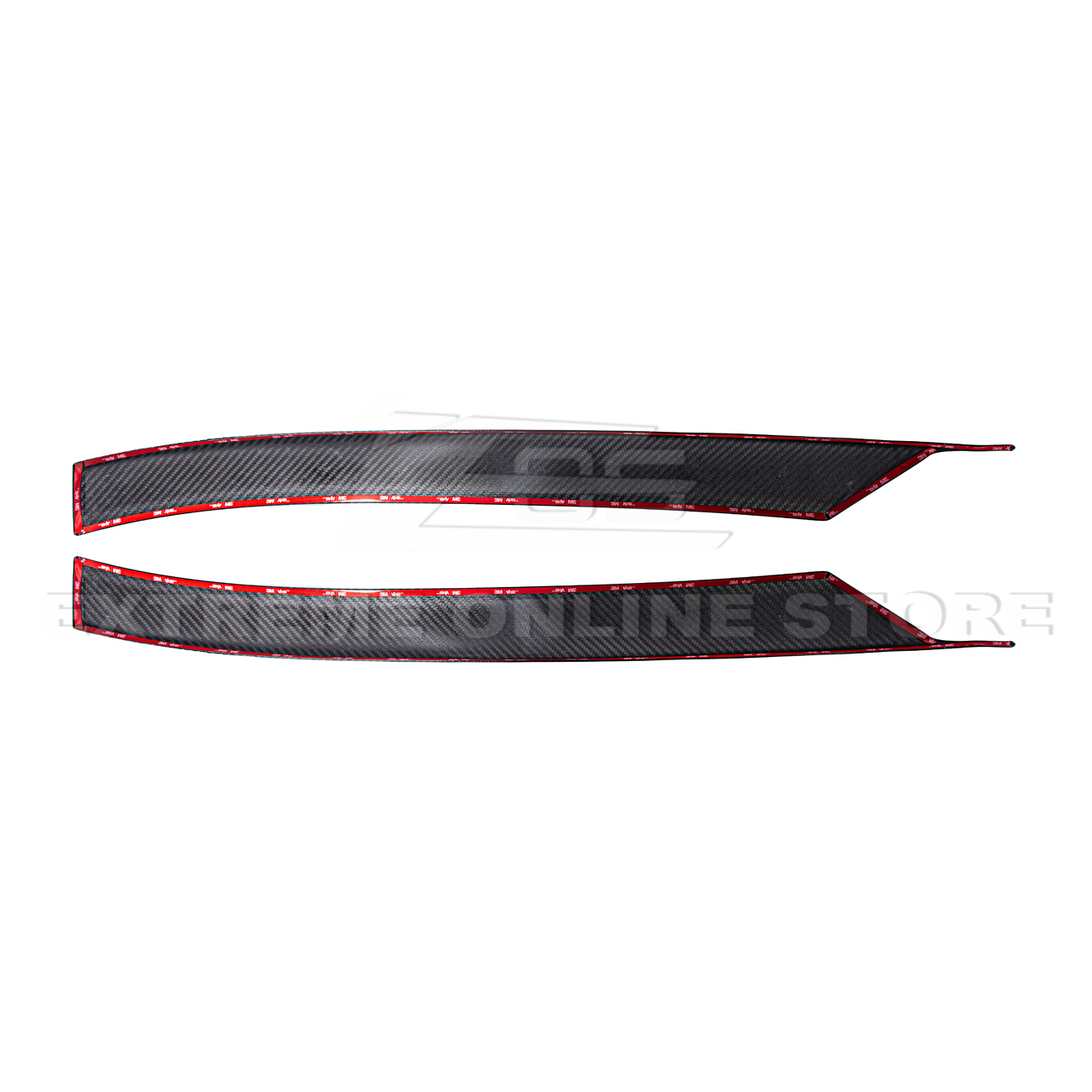
Chevrolet Corvette C8 DRY CARBON FIBER Side Window A-Pillar Cover
Chevrolet Corvette C8 DRY CARBON FIBER Side Window A-Pillar Cover
Extreme Online Store
Couldn't load pickup availability
- ✔ Verified fitment & authentic brands
- ✔ Secure checkout via Shopify, Stripe, and PayPal
- ✔ Enthusiast-run support — not a marketplace
- ✔ Fair resolution on damaged or incorrect orders
Every product is sourced from authorized manufacturers or distributors. If something isn’t right with fitment or condition, we’ll work with you to resolve it fairly.
NO GUESSWORK,
JUST PARTS THAT WORK.
Let’s finish that car.


PRODUCT DETAILS
Product Overview
Upgrade the look of your Chevrolet Corvette C8 with this premium GM Factory Style Carbon Fiber Side Window A-Pillar Cover. Designed to fit all 2020–2026 Corvette C8 models, including Stingray, Z51, E-Ray, and Z06, this upgrade enhances both aerodynamics and appearance. Manufactured using authentic 3K twill weave carbon fiber, the covers deliver a perfect balance of lightweight durability and sleek aesthetics. The glossy carbon fiber surface finish provides a high-end performance look while complementing the aggressive body lines of your Corvette. With easy tape-on installation, no drilling is required, making it an ideal choice for enthusiasts who want a quick and professional-grade exterior enhancement.
Package Included:
1 X Pair of Chevrolet Corvette C8 GM Factory Style Carbon Fiber Side A-Pillar Trim (Left & Right)
3M Tape Pre-Applied to Both Covers
Key Features
Crafted from real 3K twill weave carbon fiber, these A-pillar covers add strength and rigidity while maintaining a lightweight structure. The GM factory style ensures an OEM-like fitment and finish that blends seamlessly with the C8’s design. With a pre-applied 3M tape backing, installation is straightforward and does not require drilling or modifications. The carbon fiber finish delivers not only improved aesthetics but also long-lasting durability against heat, UV rays, and weather exposure. These A-pillar covers are engineered for Corvette owners seeking a subtle yet impactful exterior upgrade that instantly elevates the vehicle’s sporty and premium appeal.
Installation
The Chevrolet Corvette C8 Side Window A-Pillar Cover features a direct tape-on installation process. Simply clean the mounting surface, peel the protective backing from the pre-applied 3M tape, and press firmly for a secure fit. Professional installation is recommended for best results, ensuring proper alignment and adhesion. No drilling or special tools are required, making this a fast and convenient upgrade for any Corvette enthusiast.
Vehicle Compatibility
FITMENT Fits ALL 2020-Present Chevrolet Corvette C8 Models
| Year | Make | Model | Trim | Engine | Notes |
|---|---|---|---|---|---|
| 2026 | Chevrolet | Corvette | Stingray Coupe 2-Door | 6.2L V8 GAS OHV Naturally Aspirated | |
| 2026 | Chevrolet | Corvette | Stingray Convertible 2-Door | 6.2L V8 GAS OHV Naturally Aspirated | |
| 2026 | Chevrolet | Corvette | Z06 Coupe 2-Door | 5.5L V8 GAS DOHC Naturally Aspirated | |
| 2026 | Chevrolet | Corvette | Z06 Convertible 2-Door | 5.5L V8 GAS DOHC Naturally Aspirated | |
| 2026 | Chevrolet | Corvette | E-Ray Coupe 2-Door | 6.2L V8 FULL HYBRID EV-GAS (FHEV) OHV | |
| 2026 | Chevrolet | Corvette | E-Ray Convertible 2-Door | 6.2L V8 FULL HYBRID EV-GAS (FHEV) OHV | |
| 2025 | Chevrolet | Corvette | Stingray Coupe 2-Door | 6.2L V8 GAS OHV Naturally Aspirated | |
| 2025 | Chevrolet | Corvette | Stingray Convertible 2-Door | 6.2L V8 GAS OHV Naturally Aspirated | |
| 2025 | Chevrolet | Corvette | Z06 Coupe 2-Door | 5.5L V8 GAS DOHC Naturally Aspirated | |
| 2025 | Chevrolet | Corvette | Z06 Convertible 2-Door | 5.5L V8 GAS DOHC Naturally Aspirated | |
| 2025 | Chevrolet | Corvette | E-Ray Coupe 2-Door | 6.2L V8 FULL HYBRID EV-GAS (FHEV) OHV | |
| 2025 | Chevrolet | Corvette | E-Ray Convertible 2-Door | 6.2L V8 FULL HYBRID EV-GAS (FHEV) OHV | |
| 2024 | Chevrolet | Corvette | Stingray Coupe 2-Door | 6.2L V8 GAS OHV Naturally Aspirated | |
| 2024 | Chevrolet | Corvette | Stingray Convertible 2-Door | 6.2L V8 GAS OHV Naturally Aspirated | |
| 2024 | Chevrolet | Corvette | Z06 Coupe 2-Door | 5.5L V8 GAS DOHC Naturally Aspirated | |
| 2024 | Chevrolet | Corvette | Z06 Convertible 2-Door | 5.5L V8 GAS DOHC Naturally Aspirated | |
| 2023 | Chevrolet | Corvette | Stingray Coupe 2-Door | 6.2L V8 GAS OHV Naturally Aspirated | |
| 2023 | Chevrolet | Corvette | Stingray Convertible 2-Door | 6.2L V8 GAS OHV Naturally Aspirated | |
| 2022 | Chevrolet | Corvette | Stingray Coupe 2-Door | 6.2L V8 GAS OHV Naturally Aspirated | |
| 2022 | Chevrolet | Corvette | Stingray Convertible 2-Door | 6.2L V8 GAS OHV Naturally Aspirated | |
| 2022 | Chevrolet | Corvette | Z51 Coupe 2-Door | 6.2L V8 GAS OHV Naturally Aspirated | |
| 2022 | Chevrolet | Corvette | Z51 Convertible 2-Door | 6.2L V8 GAS OHV Naturally Aspirated | |
| 2022 | Chevrolet | Corvette | Z51 Performance Coupe 2-Door | 6.2L V8 GAS OHV Naturally Aspirated | |
| 2022 | Chevrolet | Corvette | Z51 Special Edition Coupe 2-Door | 6.2L V8 GAS OHV Naturally Aspirated | |
| 2021 | Chevrolet | Corvette | Stingray Coupe 2-Door | 6.2L V8 GAS OHV Naturally Aspirated | |
| 2021 | Chevrolet | Corvette | Stingray Convertible 2-Door | 6.2L V8 GAS OHV Naturally Aspirated | |
| 2021 | Chevrolet | Corvette | Z51 Coupe 2-Door | 6.2L V8 GAS OHV Naturally Aspirated | |
| 2021 | Chevrolet | Corvette | Z51 Convertible 2-Door | 6.2L V8 GAS OHV Naturally Aspirated | |
| 2021 | Chevrolet | Corvette | Z51 Performance Coupe 2-Door | 6.2L V8 GAS OHV Naturally Aspirated | |
| 2020 | Chevrolet | Corvette | Stingray Coupe 2-Door | 6.2L V8 GAS OHV Naturally Aspirated | |
| 2020 | Chevrolet | Corvette | Stingray Convertible 2-Door | 6.2L V8 GAS OHV Naturally Aspirated | |
| 2020 | Chevrolet | Corvette | Z51 Coupe 2-Door | 6.2L V8 GAS OHV Naturally Aspirated | |
| 2020 | Chevrolet | Corvette | Z51 Performance Coupe 2-Door | 6.2L V8 GAS OHV Naturally Aspirated |
About Dry Carbon Fiber
Dry Carbon Fiber vs Wet Carbon Fiber — What’s the Difference?
Not all carbon fiber parts are made the same. The biggest distinction comes down to how the carbon is processed — commonly known as dry carbon and wet carbon. Both use genuine carbon fiber weave, but the production method, finish, and performance are completely different.
Manufacturing Process
Dry carbon fiber parts are produced using a pre-preg (pre-impregnated) carbon cloth, where the exact amount of resin is pre-applied by the manufacturer. These sheets are then vacuum-sealed and cured under high pressure and temperature in an autoclave, removing excess air and resin.
The result is a light, extremely strong, and precisely formed component — the same process used in motorsport and aerospace applications.
Wet carbon fiber, on the other hand, uses a hand-lay or wet-lay method. The carbon cloth is laid into a mold and liquid resin is manually brushed or poured over it before curing. Because it’s not vacuum-bagged or autoclave-cured, there’s usually more trapped resin and air pockets, leading to a heavier part and a less uniform finish.
Weight & Strength
Dry carbon fiber is roughly 30–50% lighter than wet carbon. This is due to the controlled resin ratio — just enough to bind the fibers without unnecessary weight.
By comparison, wet carbon or carbon-over-fiberglass parts can be up to 70% heavier, since excess resin and fiberglass layers add mass without increasing stiffness.
For reference:
- Carbon Fiber Density: ~1.55 g/cm³
- Fiberglass Density: ~2.6 g/cm³
Dry carbon also offers a much higher modulus of elasticity (~125 GPa), giving it outstanding rigidity under stress — ideal for aerodynamic and high-load components.
Visual & Structural Differences
-
Backside: A true dry carbon piece will look identical front and back — you can see the same woven pattern throughout.
Wet carbon or fiberglass-backed parts often have a dull, uneven underside with visible fiberglass texture or color variation. -
Edges: Solid dry carbon has clean, uniform black edges.
Wet carbon or overlay parts may show a white or grey line along the edge, revealing the fiberglass underneath — sometimes hidden with black paint trim. -
Finish: Dry carbon typically has a consistent matte or satin finish, while wet carbon can appear glossy but uneven due to hand-applied resin.

WHY WE CARRY THIS
We only list parts we’d run ourselves or recommend to a friend building a real car. If it feels vague, unverified, or inconsistent, it doesn’t make the cut.
- Fitment-first mindset — no “universal” roulette
- Brand reputation matters — we favor proven manufacturing
- Support that actually responds with real answers
WHAT TO EXPECT
This is the clean path: correct fitment, clean install, and results that match the intent.
- Install-ready experience with correct mounting where provided
- Finish that holds up to real driving, not just photos
- Selections on this page drive the exact fitment shipped
TRUST, BUILT INTO THE PROCESS.
Anyone can list parts. We curate what belongs on a serious build. Our goal is simple: fewer surprises, cleaner installs, and confidence when you hit “Buy.”
Fitment checked
We prioritize vehicle-specific listings and clear selection logic so you’re not gambling on compatibility.
Brand discipline
Proven manufacturing and consistent quality matter more than hype. We bias toward what actually holds up.
Real support
If you have a question, you’ll get a human answer that helps you finish the build — not a copy-paste shrug.
Product Overview
Upgrade the look of your Chevrolet Corvette C8 with this premium GM Factory Style Carbon Fiber Side Window A-Pillar Cover. Designed to fit all 2020–2026 Corvette C8 models, including Stingray, Z51, E-Ray, and Z06, this upgrade enhances both aerodynamics and appearance. Manufactured using authentic 3K twill weave carbon fiber, the covers deliver a perfect balance of lightweight durability and sleek aesthetics. The glossy carbon fiber surface finish provides a high-end performance look while complementing the aggressive body lines of your Corvette. With easy tape-on installation, no drilling is required, making it an ideal choice for enthusiasts who want a quick and professional-grade exterior enhancement.
Package Included:
1 X Pair of Chevrolet Corvette C8 GM Factory Style Carbon Fiber Side A-Pillar Trim (Left & Right)
3M Tape Pre-Applied to Both Covers
Key Features
Crafted from real 3K twill weave carbon fiber, these A-pillar covers add strength and rigidity while maintaining a lightweight structure. The GM factory style ensures an OEM-like fitment and finish that blends seamlessly with the C8’s design. With a pre-applied 3M tape backing, installation is straightforward and does not require drilling or modifications. The carbon fiber finish delivers not only improved aesthetics but also long-lasting durability against heat, UV rays, and weather exposure. These A-pillar covers are engineered for Corvette owners seeking a subtle yet impactful exterior upgrade that instantly elevates the vehicle’s sporty and premium appeal.
Installation
The Chevrolet Corvette C8 Side Window A-Pillar Cover features a direct tape-on installation process. Simply clean the mounting surface, peel the protective backing from the pre-applied 3M tape, and press firmly for a secure fit. Professional installation is recommended for best results, ensuring proper alignment and adhesion. No drilling or special tools are required, making this a fast and convenient upgrade for any Corvette enthusiast.
Vehicle Compatibility
FITMENT Fits ALL 2020-Present Chevrolet Corvette C8 Models
| Year | Make | Model | Trim | Engine | Notes |
|---|---|---|---|---|---|
| 2026 | Chevrolet | Corvette | Stingray Coupe 2-Door | 6.2L V8 GAS OHV Naturally Aspirated | |
| 2026 | Chevrolet | Corvette | Stingray Convertible 2-Door | 6.2L V8 GAS OHV Naturally Aspirated | |
| 2026 | Chevrolet | Corvette | Z06 Coupe 2-Door | 5.5L V8 GAS DOHC Naturally Aspirated | |
| 2026 | Chevrolet | Corvette | Z06 Convertible 2-Door | 5.5L V8 GAS DOHC Naturally Aspirated | |
| 2026 | Chevrolet | Corvette | E-Ray Coupe 2-Door | 6.2L V8 FULL HYBRID EV-GAS (FHEV) OHV | |
| 2026 | Chevrolet | Corvette | E-Ray Convertible 2-Door | 6.2L V8 FULL HYBRID EV-GAS (FHEV) OHV | |
| 2025 | Chevrolet | Corvette | Stingray Coupe 2-Door | 6.2L V8 GAS OHV Naturally Aspirated | |
| 2025 | Chevrolet | Corvette | Stingray Convertible 2-Door | 6.2L V8 GAS OHV Naturally Aspirated | |
| 2025 | Chevrolet | Corvette | Z06 Coupe 2-Door | 5.5L V8 GAS DOHC Naturally Aspirated | |
| 2025 | Chevrolet | Corvette | Z06 Convertible 2-Door | 5.5L V8 GAS DOHC Naturally Aspirated | |
| 2025 | Chevrolet | Corvette | E-Ray Coupe 2-Door | 6.2L V8 FULL HYBRID EV-GAS (FHEV) OHV | |
| 2025 | Chevrolet | Corvette | E-Ray Convertible 2-Door | 6.2L V8 FULL HYBRID EV-GAS (FHEV) OHV | |
| 2024 | Chevrolet | Corvette | Stingray Coupe 2-Door | 6.2L V8 GAS OHV Naturally Aspirated | |
| 2024 | Chevrolet | Corvette | Stingray Convertible 2-Door | 6.2L V8 GAS OHV Naturally Aspirated | |
| 2024 | Chevrolet | Corvette | Z06 Coupe 2-Door | 5.5L V8 GAS DOHC Naturally Aspirated | |
| 2024 | Chevrolet | Corvette | Z06 Convertible 2-Door | 5.5L V8 GAS DOHC Naturally Aspirated | |
| 2023 | Chevrolet | Corvette | Stingray Coupe 2-Door | 6.2L V8 GAS OHV Naturally Aspirated | |
| 2023 | Chevrolet | Corvette | Stingray Convertible 2-Door | 6.2L V8 GAS OHV Naturally Aspirated | |
| 2022 | Chevrolet | Corvette | Stingray Coupe 2-Door | 6.2L V8 GAS OHV Naturally Aspirated | |
| 2022 | Chevrolet | Corvette | Stingray Convertible 2-Door | 6.2L V8 GAS OHV Naturally Aspirated | |
| 2022 | Chevrolet | Corvette | Z51 Coupe 2-Door | 6.2L V8 GAS OHV Naturally Aspirated | |
| 2022 | Chevrolet | Corvette | Z51 Convertible 2-Door | 6.2L V8 GAS OHV Naturally Aspirated | |
| 2022 | Chevrolet | Corvette | Z51 Performance Coupe 2-Door | 6.2L V8 GAS OHV Naturally Aspirated | |
| 2022 | Chevrolet | Corvette | Z51 Special Edition Coupe 2-Door | 6.2L V8 GAS OHV Naturally Aspirated | |
| 2021 | Chevrolet | Corvette | Stingray Coupe 2-Door | 6.2L V8 GAS OHV Naturally Aspirated | |
| 2021 | Chevrolet | Corvette | Stingray Convertible 2-Door | 6.2L V8 GAS OHV Naturally Aspirated | |
| 2021 | Chevrolet | Corvette | Z51 Coupe 2-Door | 6.2L V8 GAS OHV Naturally Aspirated | |
| 2021 | Chevrolet | Corvette | Z51 Convertible 2-Door | 6.2L V8 GAS OHV Naturally Aspirated | |
| 2021 | Chevrolet | Corvette | Z51 Performance Coupe 2-Door | 6.2L V8 GAS OHV Naturally Aspirated | |
| 2020 | Chevrolet | Corvette | Stingray Coupe 2-Door | 6.2L V8 GAS OHV Naturally Aspirated | |
| 2020 | Chevrolet | Corvette | Stingray Convertible 2-Door | 6.2L V8 GAS OHV Naturally Aspirated | |
| 2020 | Chevrolet | Corvette | Z51 Coupe 2-Door | 6.2L V8 GAS OHV Naturally Aspirated | |
| 2020 | Chevrolet | Corvette | Z51 Performance Coupe 2-Door | 6.2L V8 GAS OHV Naturally Aspirated |
About Dry Carbon Fiber
Dry Carbon Fiber vs Wet Carbon Fiber — What’s the Difference?
Not all carbon fiber parts are made the same. The biggest distinction comes down to how the carbon is processed — commonly known as dry carbon and wet carbon. Both use genuine carbon fiber weave, but the production method, finish, and performance are completely different.
Manufacturing Process
Dry carbon fiber parts are produced using a pre-preg (pre-impregnated) carbon cloth, where the exact amount of resin is pre-applied by the manufacturer. These sheets are then vacuum-sealed and cured under high pressure and temperature in an autoclave, removing excess air and resin.
The result is a light, extremely strong, and precisely formed component — the same process used in motorsport and aerospace applications.
Wet carbon fiber, on the other hand, uses a hand-lay or wet-lay method. The carbon cloth is laid into a mold and liquid resin is manually brushed or poured over it before curing. Because it’s not vacuum-bagged or autoclave-cured, there’s usually more trapped resin and air pockets, leading to a heavier part and a less uniform finish.
Weight & Strength
Dry carbon fiber is roughly 30–50% lighter than wet carbon. This is due to the controlled resin ratio — just enough to bind the fibers without unnecessary weight.
By comparison, wet carbon or carbon-over-fiberglass parts can be up to 70% heavier, since excess resin and fiberglass layers add mass without increasing stiffness.
For reference:
- Carbon Fiber Density: ~1.55 g/cm³
- Fiberglass Density: ~2.6 g/cm³
Dry carbon also offers a much higher modulus of elasticity (~125 GPa), giving it outstanding rigidity under stress — ideal for aerodynamic and high-load components.
Visual & Structural Differences
-
Backside: A true dry carbon piece will look identical front and back — you can see the same woven pattern throughout.
Wet carbon or fiberglass-backed parts often have a dull, uneven underside with visible fiberglass texture or color variation. -
Edges: Solid dry carbon has clean, uniform black edges.
Wet carbon or overlay parts may show a white or grey line along the edge, revealing the fiberglass underneath — sometimes hidden with black paint trim. -
Finish: Dry carbon typically has a consistent matte or satin finish, while wet carbon can appear glossy but uneven due to hand-applied resin.